


 Materials & Specifications Glossary
Tarpaulins, Nets and Shrink Wrap — Materials & Specifications Glossary
PE or PVC tarpaulins? Fine mesh or cord nets? How do you read film thickness, UV ratings and VCI specifications? This glossary explains the terms used when choosing covers for transport, storage, boats and scaffolding.
How to use this glossary: click a term in the index to jump to its definition. You can also press Ctrl + F (Command + F on a Mac) and type a word. On a phone, select “Find in page” from your browser menu.
Alphabetical index
Cord nets versus fine mesh nets Desiccants Double-sided tape Eyelet-free tarpaulins Film thickness Fine mesh nets Flame retardancy (FR) Grammage Heat guns for shrink wrap versus roofing torches KLY LDPE and HDPE Light transmission Micron PE versus PVC tarpaulins PE PP PVC mesh PVC Reinforced film Reusing tarpaulins RIPACK Scaffolding Shrink wrap tapes Shrink wrap UV stabilisation, UV1 and UV2 VCICord nets versus fine mesh nets — which should you choose?
Cord nets have openings formed by cords, often made from polypropylene. They are chosen for covering larger items where a strong, ventilated cover is needed. Larger openings allow airflow but will not retain small aggregates as effectively as a suitably selected fine mesh net.
Heavy-duty cord nets may offer greater tensile resistance than lightweight monofilament nets. This is not a rule for every model: compare specifications, cord diameter and edge finishing. Their openings may snag more easily on projecting parts of a load.
An ordinary cover net helps prevent material from falling out, but does not replace lashing straps or a restraint net with a confirmed load-securing capacity.
↑ Back to indexDesiccants — moisture protection beneath shrink wrap
Desiccants reduce air humidity inside a properly prepared package. They help limit condensation and the risk of corrosion during storage and transport of wrapped machinery and equipment. Film does not remove moisture sealed inside with the load.
Options for these applications include silica gel, bentonite clay and molecular sieves. Silica gel and bentonite are used in desiccant packets or bags; molecular sieves may be considered where very low humidity is required and the package is adequately sealed.
Calcium chloride desiccants are also used in container transport, often with an additive that binds absorbed water into a gel. They require appropriate packaging and installation to keep their contents from contacting the cargo.
The quantity needed depends on transport duration, climate, package sealing, water-vapour transmission through the film and moisture introduced by timber or the product itself. There is no universal number of sachets per machine. A desiccant inside a sealed cover and one in the shipping container control different spaces.
↑ Back to indexDouble-sided tape — what is it used for when wrapping?
Double-sided tape has adhesive on both faces. When installing covers, it can help position the film, hold an overlap or attach it to a suitable surface, provided the particular tape is designed for that application.
Polyethylene is a challenging surface for adhesives, so choose tape with confirmed adhesion to PE. On painted surfaces and gelcoat, first test whether the adhesive can be removed safely. Mounting tape does not automatically provide a joint able to withstand shrinking, wind and months of outdoor exposure.
↑ Back to indexEyelet-free tarpaulins — protecting boats and delicate surfaces
Eyelet-free tarpaulins have no metal fixing eyelets. Some reinforced-film tarpaulins use reinforced bands with designated piercing points instead, allowing the fixing positions to be adapted to the object being covered.
Removing metal fittings reduces the risk of local scratches to paintwork or boat gelcoat. It does not eliminate all abrasion: dirt, seams, cords and a cover moving in the wind can also damage the surface. The tarpaulin should be properly tensioned, with soft padding over sensitive areas.
↑ Back to indexFilm thickness — 180–220 µm or 250–320 µm?
Shrink film thickness is normally specified in microns (µm), not grams. The 180–220 µm range is a common starting point for many standard industrial covers used during storage and transport.
Thicker films, approximately 250–320 µm, may be considered for more demanding covers, larger unsupported spans, scaffolding and certain sea-freight applications. Scaffold film should have performance confirmed for that use; films around 300 µm are often specified.
There is no rule that thinner film will always be sufficient or that thicker film guarantees safety. Sharp edges, support, wind, exposure time, installation and the recipient’s requirements all affect the choice. Sea transport alone does not determine a single required thickness.
↑ Back to indexFine mesh nets — for aggregates and small loose loads
Fine mesh cargo nets have small openings that help retain smaller particles of a load. They can be made from PE monofilaments. They are useful for covering aggregates, waste and other materials that would pass through a larger cord-net mesh.
A dense, relatively smooth surface may slide more easily over timber or uneven loads and snag less readily than a large-mesh net. Sharp edges can still cut it. Match the mesh to the particle size: a net is not a sealed barrier against every type of dust.
↑ Back to indexFlame retardancy (FR) — what does it mean for films and tarpaulins?
FR stands for “flame retardant”. Suitable additives or coatings can reduce a material’s tendency to ignite and spread flames under specified test conditions.
Flame-retardant covers are worth considering for scaffolding, industrial premises and applications where the project specification requires them. The letters FR alone do not define a fire classification: check the documentation for the specific product, the scope of testing and the conditions of use.
Flame retardancy does not mean non-combustibility or resistance to direct exposure to a burner. B1, M1 and classifications under EN 13501-1 must not be treated as automatically equivalent.
↑ Back to indexGrammage — what does g/m² tell you?
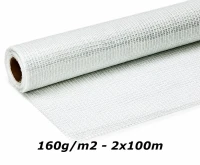
Grammage is the mass of one square metre of material, expressed in g/m². It helps compare the weight of tarpaulins and nets and estimate the mass of a complete cover. It is not a stand-alone measure of strength: construction, raw material, reinforcement and finishing quality also matter.
Grammage is not the same as thickness in microns. For a homogeneous PE film, thickness can be converted approximately into grammage using its density. For reinforced or coated tarpaulins, use the manufacturer’s specifications.
↑ Back to indexHeat guns for shrink wrap versus roofing torches
A shrink wrap heat gun is designed to heat a relatively large area of plastic and control the shrinking process. A roofing torch has a different purpose: intensive heating of bituminous materials. It should not be treated as a substitute for a shrink wrap gun.
Important features of a dedicated gun include heat distribution, power adjustment, ergonomics, gas shut-off when the trigger is released and gas-system safety devices. These help the operator work evenly, although excessive heat or insufficient distance can still burn through the film.
Shrink wrap guns differ in power, gas consumption, weight, nozzle design, hose length and compatibility with extensions. Compare the complete kit and the availability of servicing and spare parts, rather than the burner price alone.
↑ Back to indexKLY — understanding resistance to solar exposure
KLY (kLy, kilo-Langley) is a unit of accumulated solar radiant energy per unit area. Film and netting specifications may use it to describe exposure conditions or a material’s declared resistance to weathering under sunlight.
KLY is not a number of months, film thickness or the percentage of stabiliser added. It should not be equated exclusively with UV radiation either. Interpreting a figure requires the manufacturer’s stated test conditions and declaration.
The same material can age differently in Poland and in a climate with intense sunshine. Temperature, chemicals, mechanical stress and installation conditions also affect its service life.
↑ Back to indexLDPE and HDPE — two types of polyethylene
LDPE is low-density polyethylene, often used in flexible industrial films, including shrink films. HDPE is high-density polyethylene, used for products such as fibres, tapes and reinforcing meshes.
A single protective material may combine different types of PE. Its properties depend on the complete construction and additives, not just the polymer abbreviation.
↑ Back to indexLight transmission — the advantage of translucent scaffold covers
Transparent and translucent reinforced-film tarpaulins can allow daylight into an enclosed work area. This helps with façade work and reduces shading compared with an opaque cover.
Not every PE or PVC tarpaulin transmits light. Colour, thickness, construction and dirt all affect performance. “Light-transmitting” does not mean that you can see through the cover as clearly as through glass, or that it blocks all UV radiation.
↑ Back to indexMicron — how many millimetres is it?
A micron is another name for a micrometre (µm). One micron is 0.001 mm: a 200 µm film is 0.20 mm thick, while a 300 µm film is 0.30 mm thick.
For homogeneous LDPE with an assumed density of 0.92 g/cm³, a 200 µm film has an approximate grammage of 184 g/m². This is a calculation example, not a specification for every product. An order for “200 g film” should therefore be clarified: does it mean 200 µm or 200 g/m²?
↑ Back to indexPE versus PVC tarpaulins — the main differences
PE and PVC tarpaulins differ in material, weight, flexibility and typical applications. PE is often chosen for easy handling and occasional covering. PVC-coated polyester tarpaulins are frequently suitable for repeated use, sewn covers and made-to-measure protection.
Good-quality PVC materials generally offer high abrasion and mechanical resistance, but are heavier. A lighter PE tarpaulin may be easier to remove regularly. Both groups include different levels of quality, UV stabilisation and strength.
Choose according to how often the cover will be used, how it will be secured, the weather conditions and the weight the user can comfortably handle.
↑ Back to indexPE — what are polyethylene tarpaulins?
PE stands for polyethylene. A typical PE tarpaulin may consist of a core woven from polyethylene tapes and coated with plastic, or it may use a reinforced-film construction. These are different solutions despite sharing the same polymer name.
PE tarpaulins are often chosen as relatively lightweight covers for transport, gardening, construction and storage. Their durability depends on construction, grammage, fastening and UV stabilisation. Do not assume that every thin tarpaulin lacks UV stabiliser or that every thick one contains it.
↑ Back to indexPP — polypropylene in cord nets
PP, or polypropylene, is a plastic used in products such as cords and cargo nets. PP fibres absorb little water, but a wet or dirty net can retain water between fibres and on its surface.
UV resistance depends on the stabilisation of the specific product. It is not guaranteed simply by the abbreviation PP. A net’s load capacity and resistance also depend on cord diameter, construction, mesh size and edge finishing.
↑ Back to indexPVC mesh — heavier covers for intensive use
Mesh described as PVC is often made from polyester fibres coated with PVC. It combines an open structure with a durable coating and can be used to manufacture protective covers to order.
Compared with lightweight PE and PP nets, it can be heavier and more expensive. Resistance to abrasion and intensive use can be an advantage. However, check the opening size, grammage and strength of the specific material.
↑ Back to indexPVC — a material for tarpaulins and covers
PVC stands for polyvinyl chloride, also known as PCW in Polish. In many technical tarpaulins it forms a coating on a polyester fabric that provides strength. “PVC tarpaulin” therefore often describes a composite material rather than a sheet made solely of PVC.
It is used for durable covers, curtains and made-to-measure tarpaulins. Special grades may be available, such as flame-retardant or antistatic materials. These properties must be confirmed in the chosen material’s data sheet; they do not automatically apply to every PVC tarpaulin.
↑ Back to indexReinforced film — how is it different from ordinary film?
Reinforced film is a layered material with a reinforcing mesh embedded between layers of plastic. PE protective sheeting may combine high-density polyethylene reinforcement with polyethylene film layers.
The reinforcement helps distribute loads and limits the spread of a tear after local damage. It does not make the sheet resistant to every puncture or guarantee better performance than every woven tarpaulin. Tear, puncture and tensile resistance should be compared separately.
Reinforced film is not necessarily heat-shrinkable. Only film specifically intended for shrink wrapping should be heat-shrunk.
↑ Back to indexReusing tarpaulins — when is it possible?
PE, PVC and reinforced-film tarpaulins can be reused if their condition and intended application allow it. Before fitting them again, check the fastenings, tears, abrasion, seams and signs of plastic embrittlement.
Correct tensioning, protection against sharp edges and storing the cover clean and dry can help extend its life. Not all shrink wrap can be reused: a cover fitted to an object may need to be cut open for removal. No single number of seasons should be promised for every tarpaulin.
↑ Back to indexRIPACK — guns for professional shrink wrapping
RIPACK is a brand of specialist gas-powered shrink wrap guns. For example, the RIPACK 3000 features a fan-shaped heat pattern, adjustable power and the SECURIPACK system. The manufacturer also uses “cold nozzle” technology, which limits heating of the metal diffuser during normal operation.
These features are worth considering when regularly wrapping large loads. LUKATER supplies RIPACK equipment and provides authorised servicing, supporting both product selection and ongoing maintenance.
A “cold nozzle” does not mean a cold gas stream or the absence of fire risk. The tool still produces hot gases and a flame. Operate and put down the gun according to the instructions for the particular model, away from materials that could ignite.
↑ Back to indexScaffolding — reinforced sheeting or shrink wrap?
Reinforced-film tarpaulins help protect scaffolding from rain and reduce draughts. Translucent versions admit light. Reinforced fixing areas make installation easier and help distribute forces, while sheets in good condition can be reused.
Once joined and shrunk, shrink film forms a more continuous, taut cover fitted to the structure. It requires a different installation method from a ready-made tarpaulin. The choice depends on the work, duration of use, required degree of enclosure and fire-performance requirements.
Full sheeting increases the wind loads acting on scaffolding. Anchoring and the suitability of enclosing the structure must be agreed with the person responsible for its design. Strong film alone does not make a scaffold safe.
↑ Back to indexShrink wrap tapes — joining, repairs and installation
Tapes designed for PE film help hold the material in place before heat sealing, protect joints, make minor repairs and fit accessories such as access doors or vents. A suitable backing and adhesive are better matched to the film’s movement than a randomly selected packing tape.
Not every tape described as “shrink wrap tape” itself shrinks. Check adhesion to PE, temperature resistance, suitability for outdoor use and application instructions. Tape does not replace a properly made heat seal or structural fastening where these are required.
↑ Back to indexShrink wrap — how does it work and what is it used for?
Shrink wrap film contracts when heated in a controlled manner. When correctly shrunk, it forms a taut cover fitted around the load or a prepared structure. Heavy-duty industrial films protect machinery, boats, equipment and structures during transport and storage.
LDPE polyethylene is frequently used for large protective covers. Selection involves more than thickness: shrink direction and ratio, strength, UV stabilisation and any flame-retardant requirements also matter. Shrink wrap covers the load but does not replace the restraints securing it to the vehicle.
↑ Back to indexUV stabilisation, UV1 and UV2 — films, tarpaulins and nets
UV stabilisation uses measures that reduce plastic degradation caused by ultraviolet radiation. It helps outdoor materials retain their flexibility and strength for longer. It is relevant to films, tarpaulins and nets alike.
UV1 and UV2 are designations found in manufacturers’ product ranges. Without a product data sheet, do not assume that they always mean one and two years respectively. If the manufacturer of a specific film declares approximately 12 months for UV1, this must be read together with the exposure conditions and limitations of that declaration.
Stabilisation primarily protects the material itself. It does not automatically mean that all UV radiation is blocked from reaching the object beneath it. That requirement needs separate radiation-transmission data.
↑ Back to indexVCI — corrosion protection beneath film
VCI stands for volatile corrosion inhibitors. Substances released from a suitable packaging material create a protective environment around metal within an enclosed space. The technology is used for machinery, parts and equipment transported or stored under protective covers.
VCI film can be heat-shrinkable, but not every anti-corrosion film is suitable for shrinking. Check compatibility with the metals being protected, the required amount of material, protection duration and package sealing. VCI does not remove existing rust or replace surface preparation.
VCI and desiccants work differently: the inhibitor limits corrosion, while the desiccant reduces humidity. They can be combined in a properly specified packaging system, following the manufacturers’ recommendations. Not every load requires both.
↑ Back to indexNeed help choosing a protective cover?
Tell us what you need to protect, its dimensions, where it will be used and the expected exposure time. We can help you select the material and accessories: info@lukater.pl.

€71.56
€58.17

€143.38
€116.57

€836.31
€679.93

€401.59
€326.50

€634.84
€516.13

€606.77
€493.31

€14.61
Regular price:
€17.18
€11.88
Regular price:
€13.97

€10.97
Regular price:
€13.96
€8.92
Regular price:
€11.35

€453.03
€368.32
€219.84
€178.73

€92.33
€75.07

€401.59
€326.50